Airport SIM Card vs eSIM in Taiwan — Which Is Better?
Airport SIM or eSIM for Taiwan? Compare price, wait time, registration. eSIM wins: from $2.49, instant activation, no queue.
For the airport sim vs esim taiwan debate, eSIM wins every time. Skip the Taiwan Taoyuan Airport SIM card queue — install your Taiwan eSIM from eSIMYat before you board. Plans start from $2.63, activate in under 2 minutes via QR code, and connect you the moment your plane lands.
Get Taiwan eSIM — From $2.63I remember standing at Taoyuan International Airport's SIM counter at 11 PM, jet-lagged, watching a line of 40+ people shuffle forward at the pace of a slow-moving conveyor belt. I had a meeting in Taipei the next morning. That night cost me 45 minutes and a headache. Never again. That's when I switched to eSIM — and I haven't looked back across 23 countries since.
An eSIM (embedded SIM) is a digital SIM card built into your phone that allows you to download a carrier profile via QR code — no physical card, no store visit, no waiting. The GSMA eSIM standard is now supported on virtually all flagship smartphones released after 2018, making Taiwan one of the easiest countries in Asia to go fully digital for connectivity.
Taiwan runs on fast 4G LTE and expanding 5G networks — primarily through carriers like Chunghwa Telecom and Taiwan Mobile. Whether you're exploring Taipei's night markets, hiking Taroko Gorge, or working remotely from a coffee shop in Tainan, you need reliable data from the moment you land. Here's exactly how airport SIM cards and eSIMs compare — and which one actually wins.
What Is a Taiwan Airport SIM Card?
A taiwan airport sim card is a physical prepaid SIM you purchase at a counter inside Taoyuan International Airport (TPE) or Kaohsiung International Airport (KHH). Major carriers like Chunghwa Telecom, Taiwan Mobile, and FarEasTone all operate booths in the arrival halls.
These counters sell tourist SIM plans with local data, and some include limited calling. Sounds convenient — until you experience the reality.
The Reality of Buying a SIM at Taiwan Airport
- Queues at peak hours — international arrival peaks (evenings, holiday weekends) regularly create 30–60 minute waits at SIM counters
- Passport required — you must present your passport for registration, adding extra processing time
- Limited hours — SIM counters aren't always 24/7; some close after midnight flights
- No connectivity until you reach the counter — you can't message anyone, use maps, or call your hotel while waiting in line
- Fixed plans only — you pick from whatever is on the shelf, not what you actually need
- Physical SIM risk — swap your home SIM out, keep it safe, don't lose it
The taiwan sim card queue is a real pain point that thousands of travelers complain about annually. During Chinese New Year or Golden Week, that queue can stretch even longer.
What Is a Taiwan eSIM — And How Does It Work?
A Taiwan eSIM is a digital carrier profile delivered via QR code directly to your phone's eSIM slot. You scan it, confirm installation, and your phone connects to a local Taiwanese network — no physical card, no counter, no passport needed at purchase.
The process is built on the GSMA Remote SIM Provisioning spec, which allows encrypted profile downloads over the internet. When you land at TPE and your phone picks up a Wi-Fi signal — or even before you board your flight home — your eSIM is already waiting to connect.
eSIM Compatibility: Does Your Phone Support It?
Most modern smartphones support eSIM. Here's a quick compatibility check:
- iPhone XS and later — eSIM supported (note: iPhones bought in mainland China may not support eSIM)
- Samsung Galaxy S20 and later — eSIM supported
- Google Pixel 3 and later — eSIM supported
- Huawei — limited eSIM support, check your specific model
Not sure if your device works? Check the full eSIM compatible devices list before you buy.
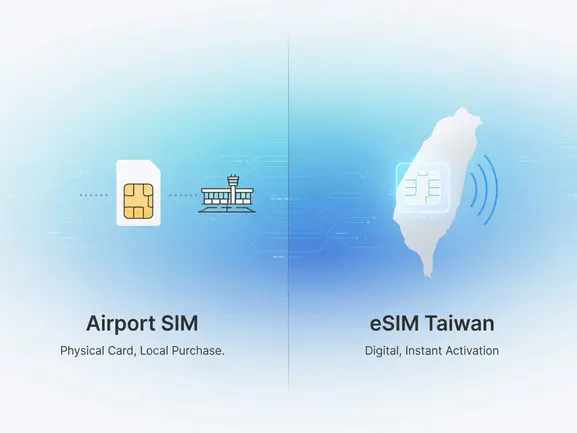
Airport SIM vs eSIM Taiwan: Head-to-Head Comparison
Let's put both options side by side. This is where the decision becomes obvious.
- Purchase timing: Airport SIM — after landing, in queue | eSIM — days before departure, from your couch
- Activation speed: Airport SIM — 30–60 minutes (queue + setup) | eSIM — under 2 minutes via QR code
- Passport required: Airport SIM — yes | eSIM from eSIMYat — no
- Connectivity on arrival: Airport SIM — after queue | eSIM — instant, the moment you land
- Dual SIM (keep home number): Airport SIM — no, swap required | eSIM — yes, keep both numbers active
- Hotspot/tethering: Airport SIM — varies by plan | eSIMYat — free on all plans
- Price transparency: Airport SIM — fixed shelf price, no comparison | eSIM — browse and compare online before buying
- Physical SIM risk: Airport SIM — lose it and you lose data | eSIM — stored digitally, nothing to lose
The verdict is clear. When you compare the airport sim vs esim taiwan options directly, eSIM saves time, reduces friction, and keeps your home number active — all simultaneously.
Why eSIMYat Is the Best Way to Buy eSIM for Taiwan
eSIMYat is a travel eSIM provider covering 150+ countries with plans starting from $1.18 and instant QR code activation. For Taiwan specifically, plans start from $2.63 — often cheaper than what you'd pay at the airport counter for a comparable data allowance.
Here's what makes eSIMYat stand out for Taiwan travel:
- Instant QR delivery — purchase now, scan in seconds, done
- No passport registration — unlike airport SIM counters, zero ID required
- Free hotspot on all plans — share data with your laptop or travel companions
- 4G/5G on premium Taiwanese networks — Chunghwa Telecom infrastructure
- 24/7 support in English and Arabic — if anything goes wrong, we're awake
- Dual SIM — your home number stays live for calls and 2FA texts
- 7-day refund policy — buy unused plan? Get your money back
I tested eSIMYat in Taiwan last spring — my eSIM connected within 8 seconds of landing at Taoyuan, before I even reached immigration. I was Google Mapping my way to the MRT while others were still joining the SIM card queue.
How Does eSIMYat Compare to Competitors for Taiwan?
You've got options in the eSIM market. Here's the honest breakdown:
- Airalo — lists Taiwan plans from around $4.50 (Airalo pricing page, checked 2026). No Arabic support. Solid but pricier for basic plans.
- Holafly — unlimited data from $6.99 (Holafly pricing page, checked 2026). Speed throttles after heavy use. Limited hotspot on most plans.
- Nomad — from $1.30/GB (Nomad pricing page, checked 2026). Offers a free trial eSIM. Good value but fewer plan options for short trips.
- Saily (NordVPN) — from $1.99 (Saily pricing page, checked 2026). Includes VPN + ad blocker. 190+ countries but VPN features not everyone needs.
- eSIMYat — plans from $2.63 for Taiwan. Arabic support, free hotspot, no passport, 7-day refund. Most value-packed for MENA and international travelers.
Want a deeper dive? See our full eSIMYat vs Airalo comparison to see exactly where the differences stack up.
How to Set Up Your Taiwan eSIM Before You Fly
Installing a Taiwan eSIM takes under 2 minutes. Do it at home, not at the airport. Here's the exact process:
- Step 1: Check device compatibility. Confirm your phone supports eSIM at eSIMYat's supported devices page. Most iPhones from XS onward and Samsung Galaxy S20+ are supported.
- Step 2: Buy your Taiwan eSIM plan. Visit eSIMYat Taiwan eSIM plans, choose your data size and duration, and complete checkout. Plans start from $2.63.
- Step 3: Receive your QR code. Check your email — your QR code arrives instantly after purchase. No waiting, no shipping.
- Step 4: Scan the QR code. Go to Settings → Mobile/Cellular → Add eSIM → Use QR Code. Point your camera at the QR code and confirm installation. The whole process takes under 90 seconds.
- Step 5: Set your data preference. In Settings, set your eSIM as the default for mobile data. Keep your home SIM active for calls and texts — dual SIM running simultaneously.
- Step 6: Disable data roaming on your home SIM. Prevents accidental roaming charges. Your eSIM handles all data at the local Taiwan rate.
- Step 7: Land in Taiwan and connect. Your eSIM activates automatically when it detects the Taiwanese network. You're online before you reach immigration — no queue, no counter, no stress.
Pro tip: Install the eSIM profile before boarding. Airport Wi-Fi is unreliable and slow — don't depend on it for QR scanning.
Taiwan Network Coverage: What to Expect
Taiwan has one of the best mobile network infrastructures in Asia. Chunghwa Telecom (CHT) covers over 99% of the populated island, including mountain trails, east coast highways, and rural areas. Taiwan Mobile and FarEasTone fill in additional coverage gaps.
5GB is enough for 7 days of maps, WhatsApp, streaming music, and light browsing in Taiwan. If you're working remotely or video-calling daily, go for 10GB or more. Coverage in the very high-altitude sections of Hehuan Mountain (above 3,000m) and some east-coast tunnels can be spotty — that's just physics, not a carrier issue.
eSIMYat Taiwan plans connect to premium local Taiwanese networks, giving you the same quality of coverage as a local resident's SIM — without the passport registration or queue.
Planning to visit other Asian destinations on the same trip? Check our regional plans for Asia eSIM coverage — a single plan can cover Taiwan, Japan, South Korea, and more.
Frequently Asked Questions: Airport SIM vs eSIM Taiwan
Is buying a SIM card at Taiwan airport worth it?
Only if you have no other option. The Taiwan airport SIM card counters at Taoyuan (TPE) offer reasonable local plans, but you'll face queues of 30–60 minutes at peak arrival times, you must show your passport, and you have no connectivity while waiting. An eSIM bought in advance is faster, cheaper, and requires no ID at checkout.
How long does the taiwan sim card queue take at Taoyuan Airport?
It depends entirely on when you arrive. During off-peak hours (early morning weekdays), you might wait 10 minutes. During peak evening arrivals, Golden Week, or holiday weekends, the taiwan sim card queue regularly stretches to 45–60 minutes. Some travelers report missing their last MRT train because of SIM counter delays.
Can I use eSIM in Taiwan on an iPhone?
Yes. All iPhones from iPhone XS (2018) onward support eSIM in Taiwan. The one exception: iPhones purchased in mainland China have eSIM disabled at the hardware level. If you bought your iPhone in China, you'll need a physical SIM. Every other iPhone variant from XS onward works perfectly with Taiwan eSIM plans.
Does eSIMYat work with hotspot in Taiwan?
Yes — free hotspot and tethering is included on all eSIMYat plans, including Taiwan. You can connect your laptop, tablet, or travel companion's device to your phone's hotspot at no extra charge. Airport SIM cards in Taiwan vary — some plans restrict tethering or charge extra for it, so always read the fine print.
What's the cheapest way to get data in Taiwan as a tourist?
The cheapest Taiwan tourist data option is a prepaid eSIM, not an airport SIM counter. eSIMYat Taiwan plans start from $2.63 — often underpriced versus what you'll find at the airport. You also avoid roaming fees entirely, since you know your exact cost before you land. Prices checked 2026-10-12.
The Bottom Line: Skip the Queue, Go eSIM
Here's what you need to take away from this guide:
- The airport sim vs esim taiwan comparison isn't close — eSIM wins on speed, price, convenience, and dual-SIM capability
- Taiwan airport SIM card counters require passport registration, involve real queues, and leave you offline while you wait
- eSIMYat Taiwan plans activate in under 2 minutes, start from $2.63, and include free hotspot with zero roaming fees
Don't let the SIM card queue be your first Taiwan experience. Buy your Taiwan eSIM from eSIMYat before you fly — plans from $2.63, instant QR activation, no passport required. Land in Taiwan connected.
Related eSIM guides
- Prepaid eSIM for Taiwan — No Contract Data Plans from $2.49
Buy prepaid eSIM for Taiwan. No contract, no commitment. Plans from $2.49. Top up anytime. Pay only for what you use.
- eSIM in Taiwan — Is It Worth It? Honest Review 2026
Honest eSIM review for Taiwan. Speed tests, coverage map, real experience. Plans from $2.49. Verdict inside.
- How to Avoid Roaming Charges in Taiwan — eSIM Solution
Stop paying roaming fees in Taiwan. Get eSIM from $2.49. Save $100+ vs carrier roaming. Instant activation.
- How Much eSIM Data Do You Need for Taiwan? Complete Guide
Calculate how much eSIM data you need for Taiwan travel. Light vs heavy usage. Recommended plans from $2.49.