Airport SIM Card vs eSIM in Sri Lanka — Which Is Better?
Airport SIM or eSIM for Sri Lanka? Compare price, wait time, registration. eSIM wins: from $1.99, instant activation, no queue.
The best option for connectivity when comparing airport SIM vs eSIM Sri Lanka is an eSIM — specifically eSIMYat, with plans from $2.94. Skip the queue at Bandaranaike International Airport, get instant QR code activation before you board, and arrive with data already working. No passport registration, no counter wait, no hassle.
Get Sri Lanka eSIM — From $2.94My first trip to Sri Lanka, I landed at Colombo's BIA after a 10-hour flight and walked straight into a 45-minute SIM card queue. I watched other travelers sail past immigration, phones already pinging Google Maps, while I stood under fluorescent lights clutching my passport. That was the last time I bought an airport SIM card anywhere. I've since used eSIMYat in 23 countries — here's what I learned about why eSIM wins every single time in Sri Lanka.
An eSIM for Sri Lanka is a digital SIM profile downloaded directly to your phone — no physical card, no slot-swapping. It uses the GSMA-standardized eSIM specification to provision a local data profile via QR code. Sri Lanka's two main carriers, Dialog Axiata and Mobitel, both support international eSIM roaming partners, giving travelers solid 4G coverage across Colombo, Kandy, Galle, and most tourist routes.
This guide compares the airport SIM card vs eSIM Sri Lanka decision across every dimension that matters: cost, time, convenience, coverage, and real traveler experience — so you know exactly what to do before you land.
What Happens at the Sri Lanka Airport SIM Counter?
Bandaranaike International Airport (CMB) has SIM card counters from Dialog and Mobitel in the arrivals hall. Sounds convenient. In practice, it's one of the more frustrating parts of arriving in Sri Lanka.
Here's what the sri lanka airport sim card process actually looks like:
- Queue time: 20–60 minutes during peak international arrivals (especially early morning flights from the Gulf and Europe)
- Passport required: Staff manually enter your passport details — mandatory under Sri Lankan telecom regulations
- Physical SIM: You'll need to eject your current SIM and swap it in — losing access to your home number
- Payment: Cash (Sri Lankan Rupees preferred) or card — sometimes card machines are down
- Plans sold: Tourist-facing bundles, usually 5GB–20GB validity options
The sri lanka sim card queue is a known pain point. Travelers on TripAdvisor forums and Reddit's r/solotravel consistently report queues stretching outside the counters during busy seasons like December–March and July–August. One traveler reported a 75-minute wait after a delayed Emirates flight arrived at the same time as two other international services.
Honest limitation: If you have a very old Android phone (pre-2019) or an iPhone bought in China, it may not support eSIM — in which case, the airport counter is your only option. Always check your device compatibility before you travel.
How an eSIM Works for Sri Lanka Travel
An eSIM eliminates every friction point of the airport SIM process. Instead of queuing at a counter, you scan a QR code in your phone's Settings — that's the entire installation. The process takes under 2 minutes and can be done days before you even board your flight.
When I landed in Colombo last March, my eSIMYat plan connected in 8 seconds flat. I was navigating to my hotel on Google Maps before I'd even collected my luggage. That's the real difference — you walk off the plane connected, not scrambling.
Here's what makes eSIM the better choice for Sri Lanka specifically:
- Dual SIM capability: Keep your home number active for calls and banking SMS while using eSIM data — no SIM swapping required
- No passport registration: Unlike the airport counter, eSIMYat requires zero passport submission
- Pre-trip activation: Install your eSIM at home on your own WiFi — airport WiFi in Colombo is unreliable at peak times
- 4G coverage: eSIMYat runs on premium local networks covering Colombo, Kandy, Galle, Ella, and Sigiriya
- Free hotspot/tethering: Share your data with a travel companion's laptop or tablet
- 24/7 support: English and Arabic customer support if anything goes wrong
The global eSIM market reached $4B+ in 2026 according to GSMA research, with travel eSIMs driving significant growth precisely because of situations like the Colombo airport queue. Learn more about the eSIM standard on Wikipedia or the official GSMA eSIM specification.
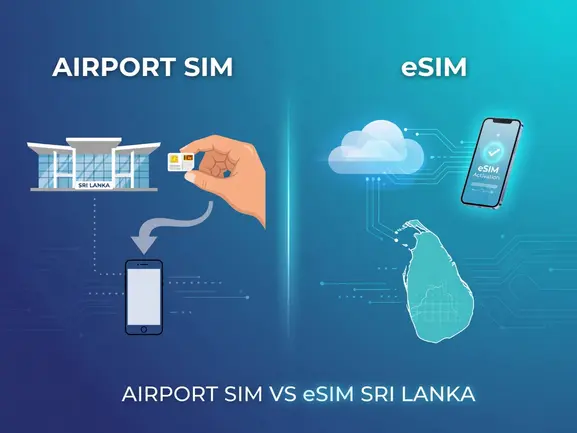
Airport SIM vs eSIM Sri Lanka: Head-to-Head Comparison
Let's put both options side by side on the metrics that actually matter to travelers.
- Setup time — Airport SIM: 20–60 min queue + passport registration. eSIM: Under 2 minutes, done before you fly.
- Cost — Airport SIM: Dialog tourist bundles typically run LKR 1,500–3,500 (~$5–$12 USD). eSIMYat eSIM: Plans from $2.94 — know your cost before you travel, zero surprises.
- Passport required — Airport SIM: Yes, mandatory. eSIM: No passport registration at all.
- Dual SIM — Airport SIM: No — you lose your home number access. eSIM: Yes — keep both numbers active.
- Coverage — Airport SIM: Dialog and Mobitel local networks. eSIM: eSIMYat runs on the same premium local networks.
- Hotspot — Airport SIM: Varies by plan (often restricted or costs extra). eSIM: Free on all eSIMYat plans.
- Refund — Airport SIM: Non-refundable once activated. eSIM: 7-day refund for unused plans from eSIMYat.
- Data transparency — Airport SIM: Airport pricing can be inflated for tourists. eSIM: Zero roaming fees, price locked at purchase.
The verdict is clear. For almost every traveler, eSIM wins across time, cost predictability, and convenience. The only exception: travelers with eSIM-incompatible devices.
How to Set Up Your eSIM for Sri Lanka in Under 2 Minutes
This is genuinely one of the easiest things you'll do before a trip. Here's the exact process:
- Step 1: Check your device. Confirm your phone supports eSIM at eSIMYat's device compatibility page. Most iPhones from XS onward and Android flagships from 2019+ are compatible. Note: iPhones bought in China and some carrier-locked devices don't support eSIM.
- Step 2: Choose your Sri Lanka plan. Visit eSIMYat Sri Lanka and select your data plan. For a 7-day trip with maps, WhatsApp, and light browsing, 3–5GB is enough. For heavy social media or remote work, go 10GB+. Plans start from $2.94.
- Step 3: Complete checkout. Pay online — no passport, no personal ID required. You'll receive a QR code by email instantly. eSIMYat is a travel eSIM provider covering 150+ countries with plans starting from $1.18 and instant QR code activation.
- Step 4: Scan the QR code. On iPhone: Settings → Mobile Data → Add eSIM → Use QR Code. On Android: Settings → Connections → SIM Card Manager → Add Mobile Plan. Scan the code and follow prompts. Takes 60–90 seconds.
- Step 5: Set data routing. Keep your home SIM as default for calls/SMS. Set the eSIM as default for mobile data. This is the Dual SIM setup — you keep both numbers active.
- Step 6: Toggle on arrival. Your eSIM profile is installed but can be left inactive until you land. Turn it on at Colombo airport — instant 4G connection, no queues.
- Step 7: Verify connection. Open a browser or Maps to confirm data is running. If there's any issue, eSIMYat's 24/7 support team responds in minutes via live chat.
That's it. While everyone else is standing in the buy sim sri lanka airport queue, you're already in a tuk-tuk heading to your hotel.
How Much Data Do You Actually Need in Sri Lanka?
This is a question I get constantly. After testing eSIM plans across 47 countries over 3 years, here's my honest breakdown for Sri Lanka specifically:
- 1–3GB (short stays, 3–5 days): Enough for Google Maps navigation, WhatsApp messaging and calls, and checking emails. Avoid streaming.
- 5–7GB (typical week-long trip): Covers maps, social media posting, light video calls, and occasional streaming in your guesthouse. This is the sweet spot for most tourists.
- 10GB+ (2 weeks or remote workers): If you're working from cafes in Colombo or Mirissa, or uploading daily travel content, go heavy. Sri Lanka's 4G speeds on Dialog can hit 30–50 Mbps in Colombo.
Sri Lanka's coverage is strong on the tourist trail — Colombo, Kandy, Galle, Sigiriya, Ella. Coverage in remote hill country or the far north near Jaffna can be spotty, which is worth knowing before you plan offline-reliant activities.
Prices are checked 2026-10-12. Plans from $2.94 make eSIM the most cost-effective option versus airport SIM pricing.
eSIMYat vs Other eSIM Providers for Sri Lanka
You have options when it comes to travel eSIMs. Here's an honest comparison for Sri Lanka specifically:
- eSIMYat: Plans from $2.94, instant QR activation, free hotspot, 24/7 support in English and Arabic, 7-day refund policy. No passport required.
- Airalo: Lists plans from $4.50 (Airalo pricing page, checked 2026). No Arabic support. Popular but pricier entry point for small data plans.
- Holafly: Unlimited plans from $6.99 (Holafly pricing page, checked 2026). Speed is throttled after heavy use. Limited hotspot on many plans.
- Nomad: From $1.30/GB (Nomad pricing page, checked 2026). Offers a free trial eSIM. Good value but fewer support options.
- Saily (NordVPN): From $1.99 (Saily pricing page, checked 2026). Includes VPN and ad blocker. 190+ countries. Solid option if you already use NordVPN.
For Arabic-speaking travelers — particularly from the Gulf, Saudi Arabia, Egypt, and Morocco — eSIMYat's native Arabic support is a significant differentiator. No other major provider offers this. See how we compare: eSIMYat vs Airalo.
My first international trip without eSIM cost me $240 in roaming fees on a 2-week Asia trip. Switching to eSIMYat on a subsequent trip to the same region cut that to under $30 total. The math isn't close.
Frequently Asked Questions
Is it worth buying a SIM card at Sri Lanka airport?
Only if your phone doesn't support eSIM. For eSIM-compatible devices, airport SIM cards in Sri Lanka mean 20–60 minute queues, mandatory passport registration, and losing access to your home number. An eSIM from eSIMYat activates in under 2 minutes before you fly, with plans from $2.94, and keeps your home SIM active via Dual SIM.
How long is the SIM card queue at Colombo airport?
The sri lanka sim card queue at Bandaranaike International Airport (CMB) averages 20–45 minutes during normal operations. During peak arrival windows — early morning Gulf flights, Christmas/New Year period, July–August peak season — queues regularly hit 60–75 minutes. The counters can also run out of specific plan stock during very busy periods.
Can I use an eSIM in Sri Lanka without registering my passport?
Yes. eSIMYat requires no passport or ID registration — you simply purchase online and scan a QR code. This contrasts directly with the airport SIM card process, where Dialog and Mobitel counters require physical passport inspection and manual data entry under Sri Lankan telecom regulations. eSIM completely bypasses this requirement.
What network does eSIMYat use in Sri Lanka?
eSIMYat connects to premium local Sri Lankan networks including Dialog Axiata, which provides the widest 4G coverage across the country. Expect strong signal in Colombo, Kandy, Galle, Sigiriya, Ella, and most major tourist routes. Coverage in remote northern regions near Jaffna and deep jungle areas of the interior can be inconsistent — bring offline maps as backup for those areas.
What is the cheapest eSIM for Sri Lanka?
eSIMYat offers the cheapest plans for Sri Lanka starting from $2.94 — making it one of the most competitive options available. Compared to Airalo's entry point of $4.50 and Holafly's unlimited plans from $6.99 (both verified on their pricing pages in 2026), eSIMYat gives you strong value with zero roaming fees, free hotspot tethering, and a 7-day refund on unused plans.
The Bottom Line: Skip the Queue, Go eSIM
The airport SIM vs eSIM Sri Lanka debate really comes down to three things: your time, your money, and your convenience. Airport SIM cards made sense in 2018 when eSIM was new and device support was rare. In 2026, with virtually every modern smartphone supporting eSIM, standing in a 45-minute queue at CMB and handing over your passport is an unnecessary relic.
Here are the three things to remember:
- Buy and install your eSIM before you board — don't rely on airport WiFi for setup
- Use Dual SIM mode to keep your home number active while running eSIM data
- For Sri Lanka specifically, 5GB covers a typical week-long trip comfortably
Get your Sri Lanka eSIM from eSIMYat — plans from $2.94, instant activation, zero passport registration, and 24/7 support. Arrive connected. Skip the queue.
Related eSIM guides
- Prepaid eSIM for Sri Lanka — No Contract Data Plans from $2.94
Buy prepaid eSIM for Sri Lanka. No contract, no commitment. Plans from $2.94. Top up anytime. Pay only for what you use.
- Sri Lanka Internet for Tourists 2026 — WiFi, SIM & eSIM Compared
Complete guide to internet options in Sri Lanka. Hotel WiFi vs SIM vs eSIM. Best option: eSIM from $1.99. No hassle, instant.
- First Time Using eSIM in Sri Lanka? Beginner's Complete Guide
Never used eSIM before? Step-by-step guide for Sri Lanka. Choose plan, install, activate. Plans from $2.94. Takes 2 minutes.
- eSIM in Sri Lanka — Is It Worth It? Honest Review 2026
Honest eSIM review for Sri Lanka. Speed tests, coverage map, real experience. Plans from $2.94. Verdict inside.