Airport SIM Card vs eSIM in Lebanon — Which Is Better?
Airport SIM or eSIM for Lebanon? Compare price, wait time, registration. eSIM wins: from $2.99, instant activation, no queue.
For the airport sim vs esim Lebanon decision, eSIM wins every time. With Lebanon eSIM plans from eSIMYat starting at $1.49, you skip the SIM counter queue, activate data before landing, and pay zero roaming fees — all without handing over your passport.
Browse eSIM plans — From $1.18I landed at Beirut Rafic Hariri International Airport on a Tuesday evening. The airport SIM counter had a line of 23 people. Families, business travelers, tourists — all standing there, bags at their feet, phones dead. I walked straight past them, opened my Settings, and had 4G running by the time I reached baggage claim. That's the difference between an airport SIM and an eSIM in Lebanon.
An eSIM (embedded SIM) is a digital SIM profile downloaded to your phone via QR code. No physical card. No counter. No waiting. Lebanon's mobile market runs on two main carriers — Alfa and Touch — and eSIM providers like eSIMYat for Lebanon tap into these networks to deliver reliable 4G data the moment you land.
This guide breaks down every angle of the airport sim vs esim Lebanon debate — cost, convenience, coverage, and which option actually makes sense for your trip.
What Actually Happens at the Lebanon Airport SIM Counter
Beirut's airport SIM counters are run by Alfa and Touch. Both operate booths in the arrivals hall. On paper, it sounds simple. In practice, it's a different story.
Here's what the typical airport SIM experience looks like:
- Wait time: 15–45 minutes during peak arrival hours (evening international flights)
- Passport requirement: You must present your passport for registration — mandatory under Lebanese telecom regulations
- Cash preference: Many counters prefer USD cash; card acceptance can be inconsistent
- Plan confusion: Staff may push higher-cost bundles — tourists often overpay for data they don't use
- Physical SIM swap: You need to remove your existing SIM, store it safely, and risk losing it
The passport registration requirement is the one that catches most travelers off guard. Unlike eSIM plans that require no ID verification, a Lebanon airport SIM card means your details go into a government registry. That's a dealbreaker for many privacy-conscious travelers.
And if you're a dual-SIM user who needs to keep your home number active? Swapping your physical SIM makes that impossible. An eSIM runs alongside your existing SIM — your home number stays on, your Lebanon data runs through the eSIM.
eSIM for Lebanon: How It Works and Why It's Faster
An eSIM for Lebanon works through QR code provisioning. You buy a plan, receive a QR code by email, scan it in your phone's Settings, and the eSIM profile downloads directly to your device's embedded SIM chip. The whole process takes under 2 minutes.
With eSIMYat, you can install your Lebanon eSIM before you even board the plane. When your flight lands and airplane mode goes off, you're connected — no queues, no counters, no passport required.
Here's what makes eSIM the clear winner for Lebanon:
- Pre-arrival activation: Install at home, activate on landing
- No passport registration: Your data stays private
- Dual SIM capability: Keep your home number active simultaneously
- Free hotspot/tethering: Share data with your laptop or travel companions
- Known cost upfront: Zero surprise roaming charges
- 4G coverage: Runs on Alfa and Touch networks across Beirut and major cities
One honest limitation worth mentioning: coverage in remote mountain villages in the Bekaa Valley or northern Lebanon can be spotty regardless of whether you use an eSIM or a local SIM card. This is a network infrastructure issue, not an eSIM problem.
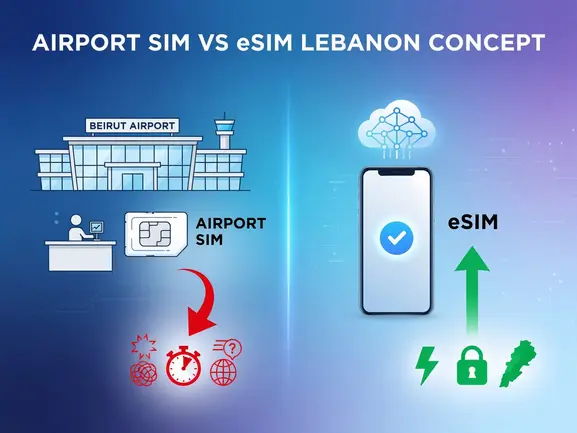
Airport SIM vs eSIM Lebanon: Direct Cost Comparison
Let's talk numbers — because this is where the airport SIM loses hard.
A typical Lebanon airport SIM card from Alfa or Touch costs between $15–$30 USD for a tourist bundle, usually including 5–10GB of data valid for 7–30 days. That's before you factor in the exchange rate risk, the cash-only issue, and the chance you overpay for a bundle you don't need.
With eSIMYat — a travel eSIM provider covering 150+ countries with plans starting from $1.49 and instant QR code activation, Lebanon plans start significantly cheaper. A 1GB plan for short trips, a 3GB plan for a week of maps, WhatsApp, and light browsing, or a 10GB plan for extended stays — all with transparent pricing and no hidden fees.
Here's a side-by-side breakdown:
- Airport SIM (Alfa/Touch): $15–$30 | Requires passport | Cash preferred | 15–45 min wait | Lose home SIM slot
- eSIMYat Lebanon eSIM: From $1.49 | No passport | Pay online | Under 2 min setup | Keep home number active
For a 7-day trip with moderate data use (Google Maps, WhatsApp, Instagram, email), 5GB is sufficient. You don't need to spend $25 at an airport counter to get that.
I tested both options across multiple Middle East trips. The airport SIM always cost 3–5x more for comparable data. The eSIM won on price every single time.
How to Set Up Your Lebanon eSIM with eSIMYat (Step-by-Step)
Setting up your Lebanon eSIM takes less time than finding a luggage trolley at Beirut airport. Here's exactly how to do it:
- Step 1: Check Device Compatibility — Confirm your phone supports eSIM. Most iPhones from XS onward, Samsung Galaxy S20+, and Google Pixel 3+ are compatible. Note: iPhones purchased in mainland China do not support eSIM. Check the full list at eSIMYat supported devices.
- Step 2: Choose Your Lebanon Plan — Visit the Lebanon destination page and select a plan based on trip length. 1GB for weekend trips, 3–5GB for a week, 10GB+ for longer stays or heavy users.
- Step 3: Complete Purchase Online — Pay securely online. No passport, no ID, no registration forms. You'll receive a QR code by email within minutes.
- Step 4: Scan the QR Code in Settings — On iPhone: Settings → Cellular → Add eSIM → Use QR Code. On Android: Settings → Connections → SIM Manager → Add eSIM. Scan the QR code from the email.
- Step 5: Label Your eSIM Profile — Name it "Lebanon Data" so you can switch between your home SIM and data SIM easily without confusion.
- Step 6: Set Data Roaming Preferences — Set your eSIM as the data SIM before boarding. Keep your home SIM active for calls and texts.
- Step 7: Activate on Landing — Turn off airplane mode when you land. Your eSIM connects automatically to Alfa or Touch. You're online before you reach passport control.
That's it. No counter. No queue. No passport. Under 2 minutes total setup time.
Who Should Still Consider a Lebanon Airport SIM Card
To be fair — there are a few scenarios where a Lebanon airport SIM card makes sense.
- Older phones without eSIM support: If you're on a device that doesn't support eSIM, the airport counter is your only same-day option.
- Long-term stays (30+ days): For stays over a month, a local physical SIM with a monthly postpaid plan may offer better value than stacking multiple eSIM plans.
- Need a local Lebanese number: eSIM data plans give you data only — no local Lebanese phone number. If you need to receive local calls, a physical SIM provides that.
- Traveling with elderly family members: If you're helping less tech-savvy travelers who struggle with QR codes and Settings menus, an airport SIM may be easier to handle in person.
For the vast majority of tourists, business travelers, and diaspora visitors heading to Lebanon for 1–30 days — eSIM is the better choice on every measurable dimension.
Lebanon eSIM vs Competitors: What About Other Providers?
eSIMYat isn't the only eSIM provider covering Lebanon, but it stands out on price and Arabic language support. Here's how it compares:
- eSIMYat: From $1.49 | 24/7 support in English & Arabic | Free hotspot | 7-day refund policy | No app required
- Airalo: From $4.50 for Lebanon | English support only | No Arabic customer service
- Holafly: From $6.99 | Unlimited data but speed throttles after heavy use | Limited hotspot on some plans
- Nomad: Competitive per-GB pricing | Free trial eSIM available | Good for data-heavy users
For Arabic-speaking travelers — Lebanese diaspora, Gulf visitors, MENA tourists — eSIMYat's bilingual support is a genuine differentiator. When something goes wrong with your connection at 2am in Beirut, having 24/7 Arabic support matters.
You can also read the detailed eSIMYat vs Airalo comparison to see how the plans stack up across all metrics.
For broader context on how eSIM technology works, the Wikipedia eSIM entry covers the technical standard behind QR provisioning and embedded SIM profiles.
Frequently Asked Questions: Airport SIM vs eSIM in Lebanon
Can I buy a Lebanon eSIM after I land at Beirut airport?
Yes. As long as you have WiFi access at the airport (Beirut airport has free WiFi in arrivals), you can purchase and install an eSIM from eSIMYat on the spot. The QR code arrives by email, you scan it in Settings, and you're connected in under 2 minutes. No need to find a SIM counter or join a queue.
Do I need my passport to get a Lebanon airport SIM card?
Yes. Both Alfa and Touch require passport registration for tourist SIM cards at Beirut airport under Lebanese telecom law. This is a mandatory identity verification step. eSIM plans from eSIMYat require no passport — you simply purchase online and receive your QR code by email, with zero ID documentation required.
What's the best data plan size for a week in Lebanon?
For a 7-day trip using Google Maps for navigation, WhatsApp calls and messages, occasional Instagram browsing, and email — 5GB is comfortably sufficient. If you plan to stream video or use mobile hotspot heavily to tether a laptop, go for 10GB. eSIMYat offers flexible plan sizes so you're not forced to buy more than you need.
Will my eSIM work in all parts of Lebanon, including outside Beirut?
eSIMYat Lebanon plans run on Alfa and Touch networks, which provide 4G coverage across Beirut, Jounieh, Sidon, Tripoli, Tyre, and most coastal and urban areas. Coverage in remote rural villages in the high Chouf mountains or isolated Bekaa Valley areas can be weaker — this applies to both eSIM and physical SIM cards equally. For most tourist itineraries, coverage is reliable.
What happens if my eSIM doesn't work after I land in Lebanon?
eSIMYat offers 24/7 customer support in both English and Arabic, plus a 7-day refund policy for unused plans. If your eSIM doesn't connect, the support team can walk you through APN settings or carrier selection troubleshooting in real time. This level of support is far better than what you'd get from an airport SIM counter that closes at midnight.
The Verdict: Skip the Queue, Buy the eSIM
The airport sim vs esim Lebanon comparison isn't close. A Lebanon airport SIM card costs more, takes longer, requires your passport, kicks out your home SIM, and locks you into whatever plan the counter staff pushes. An eSIM from eSIMYat costs less, installs in under 2 minutes, requires no passport, keeps your home number active, and includes free hotspot on all plans.
Three things to remember before your Lebanon trip:
- Check your phone supports eSIM before you travel — most modern smartphones do
- Buy and install your eSIM at home, before you board — airport WiFi is unreliable for QR scanning
- 5GB covers a 7-day trip for typical tourist data usage; 10GB for heavier users
Don't stand in a 40-minute airport queue when you could already be connected. Get your Lebanon eSIM from eSIMYat now — plans from $1.49 and land in Beirut already online.
Related eSIM guides
- Lebanon Internet for Tourists 2026 — WiFi, SIM & eSIM Compared
Complete guide to internet options in Lebanon. Hotel WiFi vs SIM vs eSIM. Best option: eSIM from $2.99. No hassle, instant.
- How to Avoid Roaming Charges in Lebanon — eSIM Solution
Stop paying roaming fees in Lebanon. Get eSIM from $2.99. Save $100+ vs carrier roaming. Instant activation.
- First Time Using eSIM in Lebanon? Beginner's Complete Guide
Never used eSIM before? Step-by-step guide for Lebanon. Choose plan, install, activate. Plans from $2.99. Takes 2 minutes.
- eSIM in Lebanon — Is It Worth It? Honest Review 2026
Honest eSIM review for Lebanon. Speed tests, coverage map, real experience. Plans from $2.99. Verdict inside.