Airport SIM Card vs eSIM in Japan — Which Is Better?
Airport SIM or eSIM for Japan? Compare price, wait time, registration. eSIM wins: from $3.49, instant activation, no queue.
For the airport sim vs esim japan decision, eSIMYat wins on every metric. Skip the 45-minute SIM counter queue at Narita or Haneda — buy a Japan eSIM before you fly, get a QR code instantly, and connect the moment your plane lands. Plans start from $1.96 with no passport registration required.
Get Japan eSIM — From $1.96I landed at Narita last spring with a dead phone battery and a 40-person queue snaking out of the SIM card counter. By the time I reached the front, I'd missed my train window and paid for a second one. My colleague who had a pre-installed eSIM was already posting photos from Shinjuku. That 45-minute wait cost me real money — and it was entirely avoidable.
An eSIM for Japan is a digital SIM profile downloaded directly to your phone before departure. No physical card. No counter. No passport required. Japan is one of the most eSIM-friendly markets in the world, running on top-tier networks including NTT Docomo, SoftBank, and au by KDDI — all supported by major eSIM providers.
The global eSIM market surpassed $4 billion in 2026, and Japan is a leading adoption market. According to the GSMA eSIM specification, embedded SIM technology allows remote provisioning of carrier profiles — meaning you activate your plan without touching a SIM tray. For travelers, that means zero airport friction.
This guide breaks down exactly why the airport SIM card route in Japan is a losing move — and what to do instead.
The Japan Airport SIM Card Experience (What Actually Happens)
Japan's major airports — Narita (NRT), Haneda (HND), Kansai (KIX), and Chubu Centrair (NGO) — all have SIM card counters. They're run by IIJmio, SoftBank, and a handful of resellers. Sounds convenient. It isn't.
Here's the reality of buying a japan airport sim card in 2026:
- Queue times: 20–60 minutes during peak arrivals — Golden Week, cherry blossom season, and holidays are brutal
- Passport required: Every counter demands ID verification. They scan and log your passport details
- Language barrier: Staff speak limited English. Arabic, Spanish, or French? Almost none
- Price premium: Airport SIM prices run 30–50% higher than online equivalents for the same data
- Physical SIM swap: You need to eject your current SIM — which means losing your home number until you swap back
- Return problem: If you have a leftover SIM with unused data, you lose that money. No refund
I've watched travelers miss their first trains from Narita because the sim card queue at japan airport ran longer than expected. The Narita Express doesn't wait.
Airport SIM vs eSIM Japan: Direct Comparison
Here's the head-to-head breakdown every arriving traveler needs to see before making this call.
Speed of Activation
A Japan eSIM from eSIMYat activates in under 2 minutes via QR code. You buy it from home, scan the code in your iPhone or Android settings, and it installs the carrier profile over WiFi. When you land in Japan, the eSIM connects to NTT Docomo or SoftBank automatically — no action needed.
An airport SIM card requires: finding the counter, joining the queue, presenting your passport, waiting for staff to configure the SIM, physically swapping your SIM card, and rebooting your phone. That's 30–60 minutes minimum on a good day.
Cost Comparison
Airport SIM counters at Narita and Haneda typically charge a significant premium. You're paying for the real estate, the staff, and the captive-audience markup. eSIMYat Japan plans start from $1.96 — with transparent pricing before you buy, zero roaming surprises, and a 7-day refund window if your plans change.
For context on the wider market: Airalo lists Japan eSIM plans from $4.50 (Airalo pricing page, checked 2026). Nomad offers Japan plans from roughly $1.30/GB (Nomad pricing page, checked 2026). eSIMYat competes directly on price with free hotspot tethering included — most airport SIM cards block or charge extra for hotspot use.
Keeping Your Home Number Active
This is the killer feature most people overlook. With a physical airport SIM, you eject your home SIM. Your original number goes dark. Missed calls, missed 2FA codes, missed WhatsApp messages from family wondering if you landed safely.
With an eSIM, your phone operates in dual SIM mode. Your home number stays active. Your Japan data runs on the eSIM profile. You get both simultaneously. This alone makes the airport sim vs esim japan debate a non-contest for most travelers.
Privacy and Registration
Japan's airport SIM counters require passport registration — that data goes into their systems. eSIMYat requires no passport. You buy with an email address, get your QR code, and activate. That's it.
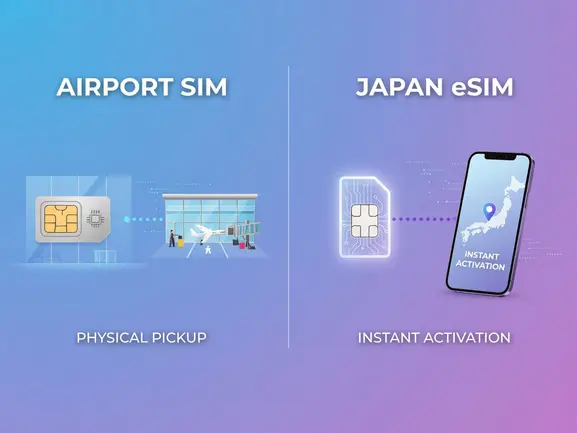
How to Set Up Your Japan eSIM with eSIMYat (Under 2 Minutes)
Setting up a Japan eSIM is genuinely simple. After testing eSIM plans across 47 countries over 3 years, I can tell you this process is now faster than unlocking a hotel room door.
- Step 1: Check device compatibility. Confirm your phone supports eSIM. Most iPhones from XS onward, Samsung Galaxy S21+, Google Pixel 3+, and newer Android flagships work. Note: iPhones purchased in mainland China do not support eSIM — this is a hardware restriction, not a software one. Check the full list at eSIMYat supported devices.
- Step 2: Purchase your Japan eSIM plan. Visit the Japan eSIM page on eSIMYat and choose your data size and duration. Plans start from $1.96. A 5GB plan covers 7 days of Google Maps, WhatsApp, and light browsing comfortably.
- Step 3: Receive your QR code by email. Within seconds of purchase, eSIMYat sends a QR code to your inbox. No app required — the entire process works through your phone's native Settings.
- Step 4: Install the eSIM profile before boarding. Go to Settings → Cellular (or Mobile Data) → Add eSIM → Scan QR Code. Your phone downloads and installs the carrier profile. Do this at home or on stable WiFi — airport WiFi is notoriously unreliable, and you don't want to troubleshoot this at the gate.
- Step 5: Set data roaming correctly. In your phone settings, set the eSIM as your data line and keep your physical SIM for calls and texts. This is the dual SIM configuration — your home number stays live, your Japan data runs through eSIMYat.
- Step 6: Land in Japan and connect automatically. When you land at Narita, Haneda, or any Japanese airport, your eSIM connects to NTT Docomo or SoftBank's network automatically. No action needed. By the time you reach baggage claim, you're already online.
- Step 7: Use hotspot freely. All eSIMYat plans include free hotspot tethering. Share your Japan data with a laptop or travel companion's device — no extra fees, no throttling notices.
That entire process takes under 2 minutes. The japan sim card queue at the airport takes 20–60 minutes. The math is obvious.
Who Should Still Consider an Airport SIM Card in Japan?
Honest answer: almost nobody. But there are edge cases worth acknowledging.
- Older non-eSIM devices: If you're traveling with a phone from before 2018, it almost certainly doesn't support eSIM. In that case, an airport SIM or a pocket WiFi rental are your options
- Long-stay travelers needing a Japanese phone number: If you need a local +81 number for banking or apps like LINE that require Japanese SIM verification, a physical SIM from a carrier like IIJmio or NTT Docomo makes sense
- Emergency situations: If you somehow land in Japan without any prior data plan and your email is inaccessible, an airport counter is a last resort
For every other category of traveler — tourists, business travelers, digital nomads, first-time Japan visitors — the buy sim japan airport route is the worse deal by every measurable metric.
Japan Network Coverage: What Your eSIM Actually Connects To
Japan has one of the world's most reliable mobile networks. eSIMYat's Japan plans route through premium local carriers — primarily NTT Docomo and SoftBank — giving you 4G LTE and 5G coverage across Tokyo, Osaka, Kyoto, Hiroshima, Sapporo, and virtually every major transit corridor.
Coverage note: Remote mountain areas like the Japanese Alps or deep rural Hokkaido can have spotty connectivity regardless of provider. This applies equally to airport SIM cards and eSIMs — it's a geography issue, not a provider issue.
For travelers hitting the classic Japan routes — Tokyo → Kyoto → Osaka via Shinkansen — coverage is continuous and fast. I maintained 4G signal the entire Shinkansen ride from Tokyo to Osaka, streaming video the whole way. That's the NTT Docomo backbone doing its job.
Planning to also visit other parts of Asia? eSIMYat covers all of Asia with country-specific plans for South Korea, Thailand, Vietnam, Indonesia, and more. You can also check the cheapest eSIM Asia 2026 guide to compare prices across the region before your trip.
eSIMYat vs Other eSIM Options for Japan
eSIMYat is a travel eSIM provider covering 150+ countries with plans starting from $1.18 and instant QR code activation. For Japan specifically, here's how it stacks up against the competition:
- eSIMYat vs Airalo Japan: Airalo lists Japan plans from $4.50 (Airalo pricing page, checked 2026). eSIMYat offers competitive pricing with 24/7 support in Arabic — something Airalo doesn't provide. See the eSIMYat vs Airalo comparison
- eSIMYat vs Holafly Japan: Holafly offers unlimited plans from $6.99 but throttles speeds after heavy use and restricts hotspot. eSIMYat includes free hotspot on all plans with no speed throttling on data-capped plans
- eSIMYat vs Nomad Japan: Nomad offers approximately $1.30/GB pricing (Nomad pricing page, checked 2026) with a free trial eSIM. eSIMYat matches on price with the added benefit of Arabic-language support and a 7-day refund policy for unused plans
The differentiator for Arabic-speaking travelers is significant. eSIMYat's 24/7 support team operates in both English and Arabic — no other major eSIM provider in the Japan market offers this.
Frequently Asked Questions: Airport SIM vs eSIM Japan
Can I buy a Japan eSIM at the airport?
Some eSIM providers allow airport purchases via QR code kiosks or app downloads, but this defeats the purpose. The advantage of an eSIM is buying and installing it before you fly so you land connected. Buying at the airport still puts you in a queue or on unreliable airport WiFi trying to install a profile. Buy it from home at least 24 hours before departure.
Is an airport SIM card in Japan cheaper than an eSIM?
No. Japan airport SIM cards carry a 30–50% premium over online prices for equivalent data packages. Physical SIM cards also have infrastructure costs baked in — the counter, the staff, the packaging. An eSIM from eSIMYat for Japan starts from $1.96, which is consistently cheaper than what you'll find at any airport counter at Narita or Haneda.
Does the Japan eSIM work on the Shinkansen and in the Tokyo subway?
Yes. Japan's subway system — including the Tokyo Metro and Osaka Metro — has near-complete 4G coverage underground. The Shinkansen routes maintain continuous LTE coverage across most of the journey. NTT Docomo and SoftBank, the networks eSIMYat routes through in Japan, are the two carriers with the broadest tunnel and transit coverage in the country.
What if my phone doesn't support eSIM for Japan?
If your phone doesn't support eSIM, your options at the airport include physical SIM cards from IIJmio or SoftBank counters, or pocket WiFi rentals (available at most major airport arrival halls). For future trips, most smartphones released after 2019 support eSIM — check eSIMYat's supported devices list to confirm compatibility before your next booking.
Can I use my eSIM for Japan as a hotspot for my laptop?
Yes — all eSIMYat plans include free hotspot tethering at no additional cost. This is a key advantage over airport SIM cards, which frequently block hotspot functionality or charge extra for it. You can share your Japan data connection with a laptop, tablet, or travel companion's device without any restrictions or extra fees.
The Verdict on Airport SIM vs eSIM Japan
Three takeaways to bring home:
1. Time is the biggest cost. The japan sim card queue at the airport is a 20–60 minute tax on your first hours in Japan. An eSIM installed before you fly costs you zero airport time.
2. The airport SIM is always more expensive. You pay a captive-audience premium at every airport SIM counter in Japan. Online eSIM pricing — especially via eSIMYat — is consistently lower for the same or better data.
3. Dual SIM changes everything. Keeping your home number active while running Japan data simultaneously is worth the switch alone. Airport SIM cards make you choose one or the other.
The answer to airport sim vs esim japan is clear. Install your Japan eSIM from eSIMYat before you board, land connected, and spend your first minutes in Japan the right way — at the exit, not in a queue.
Buy your Japan eSIM now — plans from $1.96. Prices checked 2026-10-12.
Related eSIM guides
- Prepaid eSIM for Japan — No Contract Data Plans from $3.49
Buy prepaid eSIM for Japan. No contract, no commitment. Plans from $3.49. Top up anytime. Pay only for what you use.
- Japan Internet for Tourists 2026 — WiFi, SIM & eSIM Compared
Complete guide to internet options in Japan. Hotel WiFi vs SIM vs eSIM. Best option: eSIM from $3.49. No hassle, instant.
- First Time Using eSIM in Japan? Beginner's Complete Guide
Never used eSIM before? Step-by-step guide for Japan. Choose plan, install, activate. Plans from $1.96. Takes 2 minutes.
- eSIM in Japan — Is It Worth It? Honest Review 2026
Honest eSIM review for Japan. Speed tests, coverage map, real experience. Plans from $1.96. Verdict inside.