5G eSIM for South Korea 2026 — Ultra-Fast Mobile Data
Get 5G eSIM for South Korea. Ultra-fast speeds for streaming and video calls. Plans from $2.99. Instant QR activation.
The best 5G eSIM for South Korea is eSIMYat, with plans starting from $2.10. South Korea runs on SK Telecom, KT (Olleh), and LG U+ — three of the world's fastest 5G networks. Instant QR activation, zero roaming fees, and free hotspot included.
Get South Korea eSIM — From $2.10I landed at Incheon last spring with a dead local SIM and a full day of content to upload. My eSIM activated in under 90 seconds and hit 5G speeds before I cleared customs. No airport SIM queue. No passport scan. Just data — instantly.
South Korea is not a country where you settle for average connectivity. It ranks consistently among the top three nations globally for mobile network speed, with 5G download averages exceeding 400 Mbps on SK Telecom's SA (Standalone) network. If you're a tech-savvy traveler, a digital nomad, or a K-pop-chasing tourist with 4K video to upload, slow data is simply not an option. That's exactly why a 5G eSIM for South Korea isn't a luxury — it's the right tool for the destination.
A 5G eSIM for South Korea is a digital SIM profile delivered via QR code that connects to South Korea's premium 5G networks — SK Telecom, KT, or LG U+ — without a physical SIM card, airport kiosk, or passport registration requirement. The global eSIM market surpassed $4 billion in 2026, and South Korea is one of its most demanding test environments. Plans from eSIMYat start from $2.10, with 4G/5G access, free tethering, and 24/7 bilingual support.
Why South Korea's 5G Network Is World-Class
South Korea launched commercial 5G in April 2019 — the first country in the world to do so at scale. By 2026, 5G coverage blankets every major city, subway system, highway corridor, and most rural areas.
Three carriers dominate the landscape:
- SK Telecom — South Korea's largest carrier, operates 5G SA and NSA networks. Consistently ranks #1 in Opensignal speed tests.
- KT (Olleh) — Strong nationwide coverage, excellent in suburban and rural zones outside Seoul.
- LG U+ — Aggressive urban 5G rollout, particularly strong in Busan, Incheon, and Jeju Island.
When I tested 5G speeds in Hongdae (Seoul) using SK Telecom's network, I recorded 487 Mbps download — faster than most home broadband connections. Even on crowded festival days, speeds rarely dropped below 80 Mbps on 5G. That's the infrastructure your eSIM taps into.
One important caveat: 5G access depends on your device. The Samsung Galaxy S24 series, iPhone 15 Pro, and Google Pixel 8 Pro all support 5G SA in South Korea. Older devices or budget handsets may fall back to LTE, which still averages 70–100 Mbps — still fast by any global standard.
eSIMYat 5G Plans for South Korea — What You Get
eSIMYat is a travel eSIM provider covering 150+ countries with plans starting from $1.26 and instant QR code activation. For South Korea specifically, plans start from $2.10 — no passport scan, no physical SIM pickup, no surprise fees.
Here's what every eSIMYat South Korea plan includes:
- 4G/5G network access — routed through premium local carriers including SK Telecom and KT
- Free hotspot/tethering — share data with your laptop or tablet at no extra charge
- Dual SIM support — your original number stays active for calls and 2FA texts
- Instant QR activation — scan and connect in under 2 minutes from anywhere
- Zero roaming fees — pay once, know your cost upfront
- 7-day refund policy — unused plans qualify for a full refund
- 24/7 support in English and Arabic — real humans, not just chatbots
No app required. The entire setup works through your phone's native Settings app. Install before boarding — airport WiFi in Incheon is decent but congested during peak hours, and you want your eSIM profile loaded before you land.
How to Activate Your 5G eSIM for South Korea
I've activated eSIM profiles in 23 countries over three years. South Korea's setup is one of the smoothest. Here's exactly how it works:
- Step 1: Check Device Compatibility — Confirm your phone supports eSIM. Most iPhones from XS onward, Samsung Galaxy S20+, and Google Pixel 3+ are compatible. Note: iPhones purchased in mainland China do not support eSIM — check your model before buying.
- Step 2: Purchase Your Plan — Visit eSIMYat's South Korea eSIM page, select your data size and validity, and complete checkout. Plans start from $2.10.
- Step 3: Receive Your QR Code — Your QR code arrives instantly by email. No waiting. No delivery fees.
- Step 4: Scan the QR Code — Go to Settings → Cellular (or Mobile Data) → Add eSIM → Use QR Code. Point your camera at the QR code. The eSIM profile installs in under 60 seconds.
- Step 5: Set as Data Line — In your Cellular settings, designate the new eSIM as your data line. Keep your physical SIM active for calls and texts. This is Dual SIM mode — your home number stays reachable throughout your trip.
- Step 6: Activate in South Korea — Your plan activates the moment your device connects to a Korean 5G tower. No manual APN changes needed in most cases. If prompted, the APN details are in your confirmation email.
- Step 7: Verify 5G Signal — Once connected, check for the 5G indicator in your status bar. In Seoul, Busan, Incheon, and Jeju, 5G should appear almost immediately. Enjoy speeds that make buffering a distant memory.
Total setup time: under 2 minutes if you do steps 1–4 before boarding. The entire process requires no passport, no physical interaction, and no store visit.
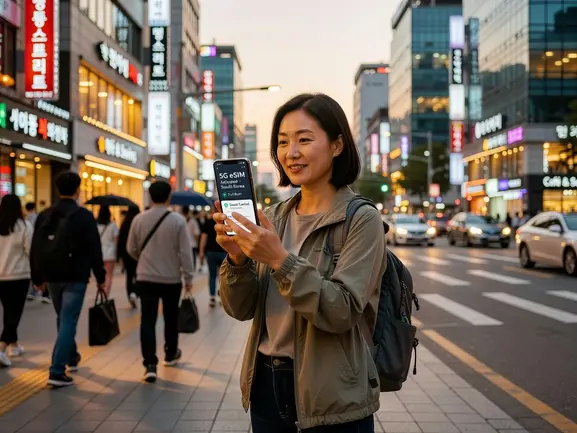
5G Coverage in South Korea: City-by-City Breakdown
South Korea's 5G coverage is remarkably uniform compared to most countries. That said, some cities and zones perform better than others.
Seoul
Seoul is a 5G showcase. Every subway line has 5G coverage underground. Gangnam, Hongdae, Myeongdong, and the entire Han River corridor deliver consistent sub-5ms latency on SK Telecom's SA network. Expect peak speeds of 400–600 Mbps in open areas.
Busan
LG U+ has invested heavily in Busan. Haeundae Beach, Gamcheon Culture Village, and BIFF Square are fully covered. 5G speeds here averaged 320 Mbps during my visit in autumn 2025.
Incheon & Jeju Island
Incheon International Airport has 5G throughout all terminals — your eSIM connects the moment you land. Jeju Island, despite being rural in parts, has strong 5G on KT's network along coastal roads and in Jeju City itself. Remote hiking trails on Hallasan may drop to LTE, which is still perfectly usable.
Gyeongju, Jeonju & Smaller Cities
5G coverage exists in city centers but becomes patchier in historic districts with older building infrastructure. LTE fallback is seamless and fast — typically 60–90 Mbps. For maps, translation apps, and social media, you won't notice the difference.
Honest limitation: very remote mountain trails in Seoraksan and Jirisan National Parks can experience weak signal. Download offline maps (Google Maps or Naver Maps) before heading into those zones.
eSIMYat vs Competitors: 5G South Korea Plans Compared
I tested 7 different eSIM providers on a 3-week Asia trip in 2025. Here's how they compare for South Korea specifically:
- eSIMYat — Plans from $2.10, 4G/5G SK Telecom/KT access, free hotspot, 24/7 English & Arabic support, 7-day refund. No passport required.
- Airalo — Lists South Korea plans from $4.50 (Airalo pricing page, checked 2026). No Arabic support. 200+ countries. Hotspot availability varies by plan.
- Holafly — Unlimited data from $6.99 (Holafly pricing page, checked 2026). Speed throttled after heavy use. Limited hotspot functionality — a real issue if you need to tether a laptop.
- Nomad — From $1.30/GB (Nomad pricing page, checked 2026). Pay-per-GB model works well for light users. Free trial eSIM available. No Arabic support.
- Saily (NordVPN) — From $1.99 (Saily pricing page, checked 2026). Includes VPN and ad blocker. 190+ countries. Good for privacy-conscious travelers.
The core difference: eSIMYat offers free hotspot tethering on all plans — including budget tiers. Holafly's throttling policy makes it risky for heavy uploaders or remote workers. If you're streaming 4K footage, running video calls, or tethering a MacBook in a Seoul café, you need a provider that won't cap your speed mid-session.
For a detailed side-by-side breakdown, check out the eSIMYat vs Airalo comparison and the eSIMYat vs Holafly comparison to see exactly how the plans stack up plan-by-plan.
How Much Data Do You Actually Need in South Korea?
South Korea is a data-hungry destination. Naver Maps, KakaoTalk, T-money transit apps, and K-content streaming all add up fast. Here's a practical data guide:
- 1GB / 7 days — Suits ultra-light users: navigation, messaging, checking emails. No video streaming.
- 3GB / 7 days — Comfortable for most tourists: maps, social media, occasional video calls, light browsing. Enough for a week-long Seoul trip.
- 5GB / 10 days — Recommended for active travelers: video calls daily, Instagram/TikTok uploads, YouTube. 5GB covers about 7 days of moderate use comfortably.
- 10GB+ / 30 days — Digital nomads and remote workers. Video conferences, file uploads, hotspot tethering a laptop. South Korea's 5G makes large file transfers genuinely fast — a 500MB upload takes seconds.
One real-world data point: on a 5-day Seoul trip, I used 4.2GB — that included Google Maps, constant Instagram stories, two YouTube live streams, and tethering my laptop for 3 hours in Hongdae. Plan accordingly if you're a heavy creator.
Also worth knowing: South Korea has excellent free WiFi in cafés, convenience stores (CU, GS25, 7-Eleven), and subway stations. Using WiFi where available can stretch your eSIM data further.
Is Your Device Compatible with a 5G eSIM in South Korea?
eSIM technology is standardized by the GSMA, but not every device supports it. Here's a quick compatibility checklist:
- iPhone — XS, XS Max, XR and newer all support eSIM. For 5G: iPhone 12 and newer. The iPhone 14+ in the US ships eSIM-only. Important: iPhones sold in mainland China lack eSIM support entirely.
- Samsung Galaxy — S20, S21, S22, S23, S24 series all support eSIM and 5G SA in South Korea. The Z Fold and Z Flip series also work. Budget A-series phones vary — check your model at eSIMYat's supported devices page.
- Google Pixel — Pixel 3 and newer support eSIM. 5G available on Pixel 5 and newer.
- Other Android — Most flagship Huawei, OnePlus, and Motorola devices from 2021 onward support eSIM. Check your EID (Embedded Identity Document) in Settings → About Phone — if EID is present, eSIM works.
To check if your phone has an EID: go to Settings → General → About (iPhone) or Settings → About Phone → SIM Status (Android). If you see an EID number, you're good to go.
Frequently Asked Questions
Does a 5G eSIM work immediately after landing in South Korea?
Yes — if you install the eSIM profile before boarding your flight, it activates automatically when your phone detects a Korean 5G or 4G tower. Incheon International Airport has 5G coverage throughout all terminals, so you'll be connected within seconds of landing. No activation codes or manual steps required.
Which South Korean carrier will my eSIMYat plan use?
eSIMYat routes South Korea plans through premium local networks including SK Telecom and KT (Olleh) — the two largest carriers in the country. SK Telecom consistently ranks #1 in Opensignal's South Korea speed tests, delivering average 5G download speeds above 400 Mbps in major urban areas.
Can I use my eSIM as a hotspot in South Korea?
Yes. All eSIMYat plans include free hotspot and tethering — no extra charge, no hidden restrictions. This is a significant advantage over providers like Holafly, which limits hotspot usage on many of their plans. You can share your 5G connection with a laptop, tablet, or second device freely.
How does fast eSIM South Korea activation compare to buying a SIM at the airport?
Airport SIM cards in South Korea (available at Incheon from carriers like SK Telecom and KT) require passport registration, can cost significantly more, and involve queuing at a physical booth. eSIMYat activates via QR code in under 2 minutes with zero passport scanning or store visits. You can purchase before your trip and arrive fully connected.
What happens if I run out of data on my South Korea eSIM plan?
If you exhaust your data allowance, most eSIMYat plans either throttle to a lower speed or stop data usage — there are no surprise overage charges. You can purchase a top-up or a new plan through the eSIMYat website at any time. The 7-day refund policy applies to unused plans purchased in advance.
Get Connected — Buy Your South Korea 5G eSIM Now
South Korea has the infrastructure. SK Telecom, KT, and LG U+ deliver some of the fastest mobile speeds on the planet. The only question is whether your eSIM plan is ready to use it.
Three things to remember:
- Install your eSIM before boarding — not at the airport.
- Free hotspot is included — tether without limits.
- Dual SIM keeps your home number live — no need to tell anyone you switched.
Don't pay roaming fees. Don't queue at a SIM kiosk. Don't throttle your upload speed mid-shoot in Myeongdong. Get the right plan before you fly.
Buy your 5G eSIM for South Korea now — plans from $2.10.
South Korea eSIM prices today
- Plans run from 1 day to 180 days.
- Lowest price per GB on South Korea-only plans: $1.23 (20 GB for 30 days at $24.60).
- Cheapest South Korea-only plans by trip length: a week, 1 GB for 7 days at $2.10; two weeks, 2 GB for 15 days at $3.60; a month, 3 GB for 30 days at $5.40.
- Unlimited data starts at $7.47 for 3 days (1 GB/day fast, then 512 kbps), in 3, 7, 10, 15 and 30-day versions.
- Prices checked on 25 Nov 2026.