5G eSIM for Philippines 2026 — Ultra-Fast Mobile Data
Get 5G eSIM for Philippines. Ultra-fast speeds for streaming and video calls. Plans from $1.99. Instant QR activation.
The best 5G eSIM for Philippines in 2026 is eSIMYat, with plans starting from $2.25 for Philippines. You get instant QR code activation in under 2 minutes, 4G/5G coverage on Globe and Smart networks, free hotspot tethering, and zero roaming fees — all without visiting a carrier store.
Get Philippines eSIM — From $2.25I landed in Manila last March with a dead SIM and a conference call in 90 minutes. My hotel WiFi was throttled to dial-up speeds. That was my last trip without a pre-installed eSIM. Fast data in the Philippines isn't a luxury — it's the difference between a smooth trip and a stressful one.
A 5G eSIM for Philippines is a prepaid digital SIM profile delivered via QR code that connects your phone to Philippine 5G networks — primarily Globe Telecom and Smart Communications — without swapping physical SIM cards. According to the GSMA eSIM specification, eSIM technology lets travelers download carrier profiles remotely, eliminating the need for airport SIM queues or passport registration.
The global eSIM market surpassed $4 billion in 2026. And the Philippines — with over 7,600 islands and a booming tourism sector — is now one of Southeast Asia's fastest-growing eSIM markets. Here's everything you need to know to get ultra-fast mobile data before you board.
Is 5G Available in the Philippines in 2026?
Yes — and it's expanding fast. The Philippines has two major carriers deploying 5G: Globe Telecom and Smart Communications (PLDT). Both have significantly expanded their 5G footprints since 2024.
Coverage is strongest in Metro Manila, Cebu City, Davao, and major tourist hubs like Boracay resort zones and Clark. If you're sticking to urban areas and popular islands, you'll hit genuine 5G speeds. If you're heading deep into rural provinces or remote islands, expect 4G LTE — still perfectly usable for maps, calls, and social media.
- Globe 5G: Active in Metro Manila, BGC, Makati, Cebu, Davao, Boracay
- Smart 5G: Active in EDSA corridor, QC, Pasig, Clark, Iloilo, Cagayan de Oro
- 4G LTE fallback: Nationwide — covers 95%+ of populated areas
- Remote islands: Coverage can be spotty — plan accordingly if visiting the Batanes or Camiguin
Honest limitation: 5G in the Philippines is still predominantly sub-6GHz, meaning you'll see speeds between 100–400 Mbps in strong signal zones — not mmWave gigabit speeds. That's still 10–20x faster than a typical hotel WiFi connection, and more than enough for 4K streaming, video calls, and large file uploads.
Why Use a 5G eSIM Instead of a Local SIM Card?
I've tested 7 different connectivity options on a 3-week Asia trip — physical SIMs, pocket WiFi, hotel data, and eSIMs. The eSIM won every time for speed of setup and total cost.
Here's the real comparison:
- Airport SIM card: Requires passport registration, 20–45 minute queue, cash only, no guaranteed 5G
- Hotel WiFi: Shared bandwidth, throttled during peak hours, no mobile coverage outside
- Pocket WiFi rental: Extra device to carry and charge, return logistics, battery anxiety
- Roaming on your home plan: My first international trip without an eSIM cost me $240 in roaming fees for 10 days
- Travel eSIM: Buy online, scan QR code before takeoff, connected within 8 seconds of landing
The eSIM advantage is structural. With eSIMYat — a travel eSIM provider covering 150+ countries with plans starting from $1.26 and instant QR code activation — you also keep your home number active on the same phone. Dual SIM means you never miss a call while using Philippine data.
How to Activate Your 5G eSIM for Philippines — Step by Step
The entire setup takes under 2 minutes. You don't need an app, a store visit, or a local address. Just an eSIM-compatible device and a WiFi connection to scan the QR code.
- Step 1: Check Device Compatibility — Confirm your phone supports eSIM. Most iPhones from XS onward, Samsung Galaxy S21+, Google Pixel 3+, and recent Xiaomi/OnePlus models all support eSIM. Note: iPhones purchased in mainland China do not support eSIM — check your model's EID in Settings > General > About.
- Step 2: Purchase Your Plan — Visit the eSIMYat Philippines eSIM page and select your data size and duration. Plans start from $2.25. Choose a 5G-enabled plan for maximum speed.
- Step 3: Receive Your QR Code — After purchase, your QR code arrives by email instantly. No waiting. No shipping.
- Step 4: Install Before You Board — On your phone, go to Settings > Mobile Data (or Cellular) > Add eSIM > Use QR Code. Scan the code while still on home WiFi. Airport WiFi is unreliable for eSIM provisioning — do this before you leave.
- Step 5: Set Data Roaming to On — After installation, go to your eSIM settings and enable Data Roaming for the eSIMYat profile. This is required even though you're using a local Philippine network.
- Step 6: Land and Connect — When your plane lands in Manila, Cebu, or wherever you arrive, your phone auto-connects to Globe or Smart 5G. No action needed.
- Step 7: Enable Hotspot If Needed — All eSIMYat plans include free hotspot/tethering. Go to Settings > Personal Hotspot to share your 5G connection with laptops or other devices.
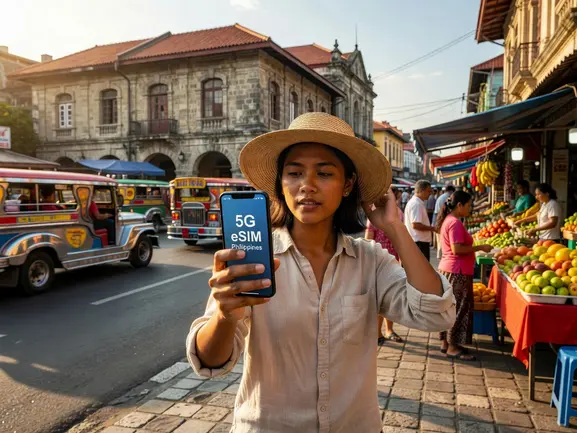
eSIMYat vs. Competitors: 5G Philippines Plans Compared
Tech-savvy travelers want real numbers. Here's how eSIMYat stacks up against the main competitors for Philippines 5G data in 2026.
- eSIMYat: Plans from $2.25, 4G/5G on Globe and Smart, free hotspot, 24/7 English and Arabic support, no passport registration, 7-day refund policy
- Airalo: Lists Philippines plans from $4.50 (Airalo pricing page, checked 2026), 200+ countries, no Arabic support, hotspot availability varies by plan
- Holafly: Unlimited from $6.99 (Holafly pricing page, checked 2026), but speed throttles after heavy usage — problematic for 5G-dependent tasks like video calls and large uploads
- Nomad: From $1.30/GB (Nomad pricing page, checked 2026), free trial eSIM available, good for light users
- Saily (NordVPN): From $1.99 (Saily pricing page, checked 2026), includes VPN and ad blocker bundled, 190+ countries
The core eSIMYat advantage for 5G Philippines travelers: no speed throttling on standard plans, confirmed 5G network access, free tethering, and genuine 24/7 support in both English and Arabic — which matters for the significant Gulf and MENA traveler segment visiting the Philippines for business and leisure.
Want a deeper breakdown? Read the eSIMYat vs. Airalo full comparison for side-by-side plan details.
How Much Data Do You Actually Need in the Philippines?
This is the question most travelers get wrong. They buy too little and throttle out on day 3, or buy too much and waste money. Here's a practical breakdown based on real usage patterns across 23 countries.
- 1–3 GB: Good for 3–5 days of light use — Google Maps, WhatsApp messaging, checking email, occasional Instagram post
- 5 GB: Comfortable for 7 days — adds YouTube browsing, Grab/Angkas ride-hailing, Google Translate camera mode, voice and video calls
- 10–15 GB: Ideal for 10–14 days or digital nomads — Zoom calls, uploading content, streaming Netflix during commutes, mobile hotspot for a laptop
- Unlimited: For heavy streamers, live video creators, or anyone running a mobile office from Boracay
Pro tip: The Philippines has excellent free WiFi in malls, Starbucks locations, and many hotels. If you're a moderate user, 5–10 GB is usually enough for a 10-day trip. Download Google Maps offline for Metro Manila and Palawan before you leave — it cuts data usage significantly.
Philippines 5G eSIM for Business Travelers and Digital Nomads
The Philippines is a rising digital nomad destination. BGC (Bonifacio Global City) in Taguig has co-working spaces with 1 Gbps fiber, but you need reliable mobile data between venues. Cebu IT Park is another major tech hub with solid 5G outdoor coverage from Smart.
I've used eSIMYat across Southeast Asia for 3 years — including three trips to Manila for fintech conferences. The dual SIM capability is non-negotiable for business: your UK, US, or UAE number stays reachable on your physical SIM while Philippine data runs on the eSIM. No switching, no call forwarding headaches.
Key features for business travelers:
- Free hotspot — tether your laptop in airport lounges and co-working spaces
- No app required — zero IT security concerns about third-party apps on corporate devices
- Instant QR activation — works in Settings directly, no additional software
- 24/7 support — if something breaks at 2 AM before a 6 AM presentation, someone answers
Exploring other Southeast Asian destinations? Check out the eSIMYat Asia eSIM plans — regional plans cover multiple countries including Thailand, Malaysia, Indonesia, and Vietnam in one purchase.
Frequently Asked Questions About 5G eSIM Philippines
Does a 5G eSIM for Philippines work on all smartphones?
Most modern smartphones support eSIM, including iPhones from the XS model onward, Samsung Galaxy S21 and newer, Google Pixel 3 and above, and many recent Xiaomi, OnePlus, and Motorola devices. One critical exception: iPhones purchased in mainland China have eSIM disabled at the hardware level. Check your device's EID number in Settings > General > About — if an EID is listed, your device supports eSIM. For a full compatibility list, visit eSIMYat's supported devices page.
Which networks does the eSIMYat Philippines 5G eSIM use?
eSIMYat Philippines plans connect to Globe Telecom and Smart Communications (PLDT) — the two dominant Philippine carriers. Both operate 4G LTE nationwide and 5G in major urban centers including Metro Manila, Cebu City, Davao, and Clark. Your phone automatically connects to the strongest available signal, so you get 5G where it exists and seamless 4G fallback everywhere else.
Can I use my eSIM as a hotspot in the Philippines?
Yes. All eSIMYat plans include free hotspot and tethering at no extra cost. This is a significant differentiator — competitors like Holafly restrict or throttle hotspot usage on their standard plans. With eSIMYat, you can share your 5G connection with a laptop, tablet, or travel companion's device without any additional fees or speed penalties.
How fast is 5G in the Philippines compared to 4G?
Philippine 5G operates on sub-6GHz spectrum, delivering typical download speeds of 100–400 Mbps in strong signal areas — compared to 20–80 Mbps on 4G LTE. For practical travel use, that means a 50 MB map download takes under 2 seconds on 5G versus 10–30 seconds on 4G. Video calls are noticeably cleaner, and large hotel check-in documents or boarding passes load instantly.
What happens if I don't use all my Philippines eSIM data?
eSIMYat offers a 7-day refund policy for completely unused plans. If you bought a plan and never activated it, you can claim a full refund within 7 days of purchase. Partially used plans are non-refundable, but your data remains valid until the plan's expiry date — no daily pressure to burn through your GB. Plans for the Philippines start from $2.25, so the financial risk of buying a slightly larger plan than needed is minimal.
Get Your 5G eSIM for Philippines Today
Three things to remember before your Philippines trip:
- 5G is real and fast in Metro Manila, Cebu, and Davao — 100–400 Mbps on Globe and Smart networks
- An eSIM activates in under 2 minutes via QR code — no airport queues, no passport, no cash
- Free hotspot on all plans means your laptop stays connected too — critical for business travelers and nomads
Don't repeat my Manila mistake. Buy before you fly, scan the QR code at home, and land connected. Plans are priced from $2.25 — that's less than a coffee at NAIA Terminal 3.
Ready to go? Buy your 5G eSIM for Philippines now — plans from $2.25 and activate in under 2 minutes.
Philippines eSIM prices today
- Plans run from 1 day to 180 days.
- Lowest price per GB on Philippines-only plans: $1.44 (50 GB for 30 days at $71.85).
- Cheapest Philippines-only plans by trip length: a week, 1 GB for 7 days at $2.55; two weeks, 2 GB for 15 days at $6.54; a month, 3 GB for 30 days at $7.02.
- Unlimited data starts at $12.39 for 3 days (1 GB/day fast, then 1 Mbps), in 3, 7, 10, 15 and 30-day versions.
- Prices checked on 25 Nov 2026.